
What Foods Are You Really Eating?
Picture your typical day of eating. Maybe you start with toast or cereal, snack on fruit between meetings, grab a sandwich for lunch, boil pasta for dinner, or toss together a salad. These feel like the healthy, simple staples we’ve all been encouraged to eat more of. But what if the very foods we rely on most are also the ones delivering the highest amounts of microplastics into our bodies? Microplastics are tiny plastic particles less than 5 millimeters in size, thinner than human hair and finer than grains of salt, and mounting evidence shows that these particles are finding their way into nearly every part of our diet.
A New Global Review Reveals a Surprising Source of Microplastics in Food
Researchers from the University of Amsterdam have just published a sweeping new peer-reviewed review titled “Exposure to microplastics from food: Comparative analysis of food types and quantification techniques” in the Journal of Hazardous Materials (2026). This study collected data from 193 published research papers measuring microplastic counts in food, plus an additional 12 studies that measured plastic mass. The team examined microplastics across 13 categories of foods and drinks, from grains, vegetables, fruits, and meat to shellfish, drinking water, beer, milk, salt, sugar, and honey. Their goal was simple: identify where microplastics are truly coming from in the human diet. And the results turned a long-held assumption on its head.
It Doesn’t Matter If You Avoid Seafood
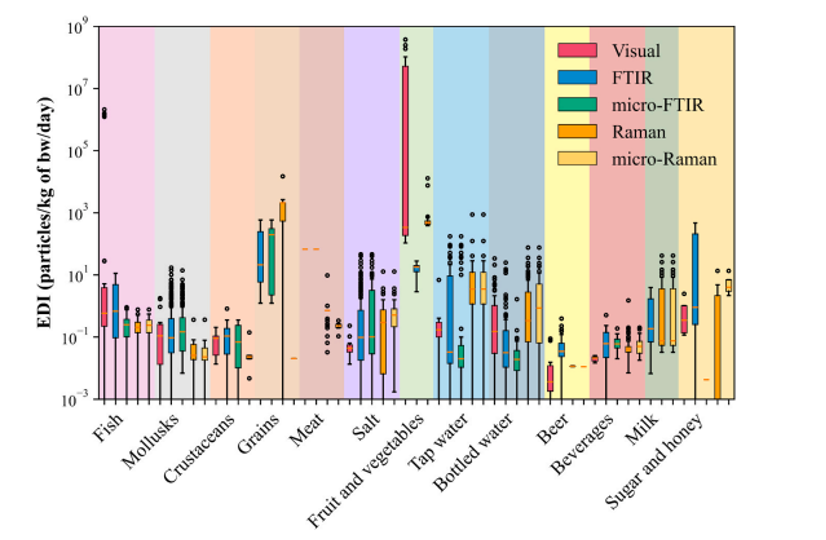
For years, seafood has been thought of as the primary source of microplastics in our diet. And while shellfish and crustaceans certainly do contain high concentrations, this new analysis found that the foods contributing the most microplastics to our daily intake are fruits, vegetables, and grains, the very foods most of us eat several times every day. These categories showed the highest estimated daily intake values, with fruit and vegetables standing out as the largest contributor, even surpassing seafood, bottled water, and other drink categories by entire orders of magnitude. In fact, the study estimated that fruit, vegetables, and grains together account for roughly 99.5% of all microplastic particles consumed daily, largely because they are eaten so frequently.
Why Are Produce and Grains So Contaminated?
Plants grow in soil, and as it turns out, soil has become a major long-term sink for microplastics. Plastic debris breaks down into tiny particles that mix into agricultural soils through multiple pathways: the degradation of plastic mulch films used in farming, the application of wastewater-derived biosolids as fertilizer, contamination from irrigation water, and even fallout from airborne microplastics drifting through the air. Fruits and vegetables can accumulate these particles either internally or on their surfaces, meaning produce may come “pre-seasoned” with microplastics before it ever reaches your kitchen. Even grains, harvested and processed in bulk, show consistently high microplastic levels across studies, regardless of geographic location.
Hidden Plastics in Everyday Ingredients
It doesn’t end with produce. The researchers found microplastics in nearly every food category they analyzed. Salt, sugar, and honey all contained measurable particles. Both bottled and tap water are also a consistent source, though tap water contributed more to total exposure simply because people drink more of it. Bottled water often contained slightly higher concentrations of microplastics, likely due to packaging, but overall, its impact on daily intake was lower because most people consume far less of it. Beer and other beverages contained microplastics too, though at much lower levels than foods like grains or vegetables.
When the researchers combined all available data and modeled global food consumption patterns, they found that people ingest anywhere from 7.7 × 10⁻³ to 3.8 × 10⁸ microplastic particles per kilogram of body weight per day, with a median of 721 particles per kilogram, or around 330 microplastics per pound. For an average American adult, that amounts to almost 60,000 microplastic particles every single day, a number many times higher than earlier estimates. The reason the older numbers were so much lower? Those studies didn’t include fruit, vegetables, or grains. Now that they have, the picture of human microplastic exposure is far more unsettling.
Should You Be Concerned?
Although we do not yet fully understand the health effects of consuming microplastics, research has already linked them to inflammation, hormone disruption, and the potential to carry toxic chemicals into the body. These concerns are especially relevant when microplastics break down into even smaller particles, called nanoplastics, which can enter organs and tissues more easily.
How You Can Help
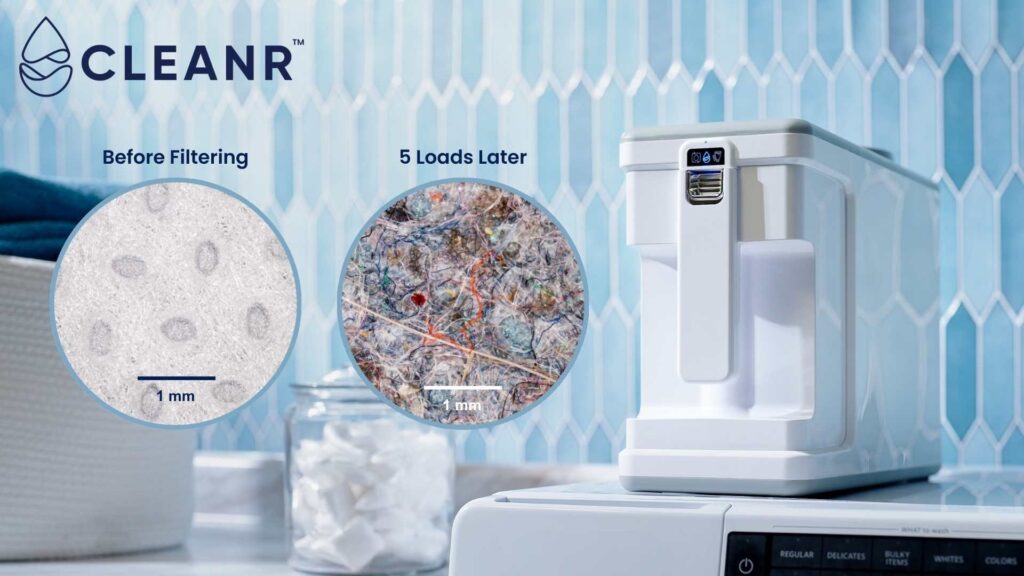
Microplastics are appearing in some of the most unexpected corners of the natural world, from the highest peaks to the lowest depths of our Earth. But it doesn’t have to be this way. Research has shown that laundry machines are the leading source of microplastic pollution. CLEANR’s Premium Microplastic Filter for washing machines captures 90%+ of microplastics from the laundry, preventing them from entering our environment.
About CLEANR
CLEANR builds best-in-class microplastic filters for washing machines that effortlessly remove the largest source of microplastics into the environment. Its technology, VORTX, represents a breakthrough in filtration, with a patent-pending design that is inspired by nature and proven to outperform conventional filtration technologies by over 300%. The company is building a platform filter technology that enables product manufacturers and business customers to materially reduce their microplastic emissions from impacted in-bound and out-bound fluid streams, including residential and commercial washing machine wastewater, in-home water systems, wastewater treatment, textile manufacturing effluents, industrial wastewater, and other sources. www.cleanr.life
Sources
- Hayder, M., Laan, M.M., & van Wezel, A.P. (2026). Exposure to microplastics from food: Comparative analysis of food types and quantification techniques. Journal of Hazardous Materials, 501, 140657. https://doi.org/10.1016/j.jhazmat.2025.140657
Ullah, S., Ahmad, S., Guo, X., Ullah, S., Ullah, S., Nabi, G., & Wanghe, K. (2023, January 16). A review of the endocrine disrupting effects of micro and nano plastic and their associated chemicals in mammals. Frontiers in Endocrinology, 13, 1084236. https://doi.org/10.3389/fendo.2022.1084236
More on Microplastic
- Microplastics

- Microplastics

- Microplastics