
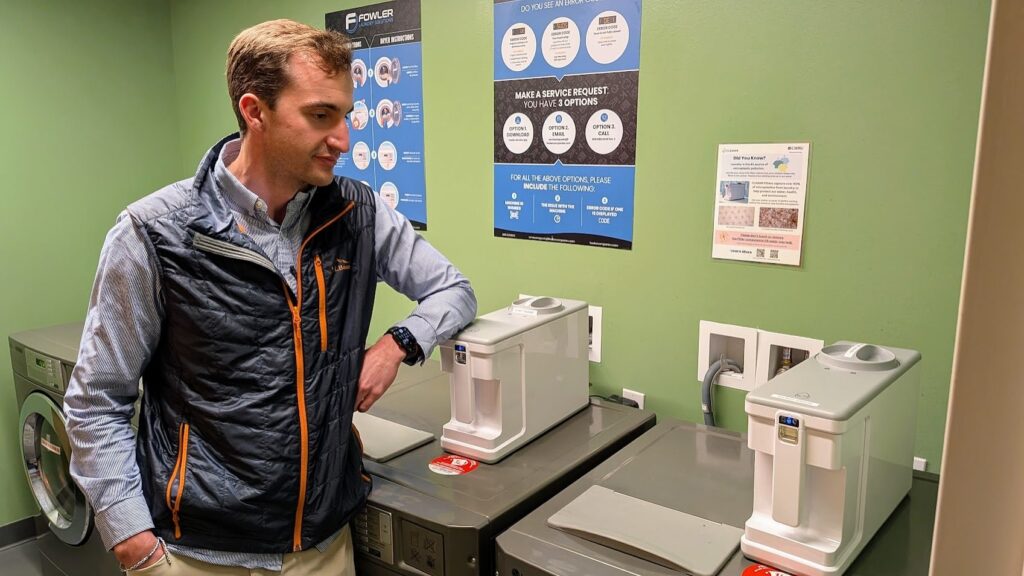
Clothing and textiles are the largest source of microplastics in the environment, shedding millions of tiny fibers every time they’re washed. To help reduce this impact, a pilot program launched earlier this year at Case Western Reserve University, beginning with five washing machines in CWRU’s Stephanie Tubbs Jones Hall.
By October, the program expanded to 100 microplastic filters installed across 23 dormitories, bringing filtration to nearly all on-campus laundry facilities where space allowed. The initiative has since grown to include additional universities, including the University of Akron and the University of South Alabama.
The filters installed on campus capture up to 90% of microplastics as small as 50 microns, preventing them from entering wastewater systems. As research increasingly links microplastics to environmental and human health concerns, with projections suggesting pollution levels could double by 2040, efforts like this demonstrate how institutions can take meaningful, immediate action.
For CLEANR, seeing this program scale at Case Western Reserve University is a significant milestone and an exciting step forward in reducing microplastic pollution where it starts.
# # #
About CLEANR
CLEANR builds best-in-class microplastic filters for washing machines that effortlessly remove the largest source of microplastics into the environment. Its technology, VORTX, represents a breakthrough in filtration, with a patent-pending design that is inspired by nature and proven to outperform conventional filtration technologies by over 300%. The company is building a platform filter technology that enables product manufacturers and business customers to materially reduce their microplastic emissions from impacted in-bound and out-bound fluid streams, including residential and commercial washing machine wastewater, in-home water systems, wastewater treatment, textile manufacturing effluents, industrial wastewater, and other sources. www.cleanr.life
More on Cleanr

- CLEANR
- CLEANR
- CLEANR